Choose reading mode (more settings inside the app)
Techniques that help ADHD readers not just understand what they read, but still have it a month later.
Understanding a page and remembering it are two separate jobs, and ADHD tends to leave the second one unfinished. Five techniques do most of the work of fixing that, and they are spaced repetition, elaboration, mnemonics, teaching the material back to someone, and multi-sensory review. Each one forces the information through a second deliberate pass, which is what moves it out of fragile short-term memory and into somewhere you can reach it later. Comprehension in the moment is often perfectly fine, especially on a topic you care about, and then it quietly evaporates and leaves you with a vague sense of having read something once. That gap between understanding and keeping is what this guide is about.

What follows is written for adults and students with ADHD who are tired of losing what they read within a week of reading it. These strategies work with how an ADHD brain actually operates rather than against it, and none of them ask for more willpower, which is the usual advice and the usual point of failure. What they ask for instead is doing something specific with the material once you have finished reading it. Try one on the next chapter you complete and check what is still there in seven days, because most people are surprised by how much a single deliberate pass changes the result. The reading itself does not need to take any longer, since it is the five minutes afterwards that decide whether the material stays.
Why Remembering What You Read is Tough with ADHD
The ADHD Brain and Information Processing
ADHD means the brain handles incoming information differently, and three features of that difference hit retention directly. Working memory comes first, and it helps to think of it as the brain's sticky note, one that with ADHD holds less and holds it less firmly than it needs to. Information has to sit in working memory long enough to be encoded into long-term storage, so when the note falls off early nothing ever gets filed. Sustained attention and executive function account for the rest, and both of them are working continuously the whole time you read. The mechanism behind all three is set out in our explainer on why reading is so hard with ADHD.
Distractibility does the other half of the damage. You start a chapter with genuine intent, attention slides away somewhere around the second page, and you finish with holes where the connective material should have been. There is nothing to retain because nothing was fully taken in, since attention decides how much reaches working memory at all while executive function decides what happens next, including whether you even notice that you have stopped understanding. When all three run short at the same time, the page goes in and nothing comes back out. None of this reflects intelligence, since it is wiring, and wiring can be worked around once you know what it is doing to you. For more context, see our article on comprehension strategies for ADHD readers.
Comprehension and Retention Are Not the Same Thing
These two are worth separating clearly, because conflating them leads people to blame the wrong stage. Comprehension is understanding a concept while it sits in front of you, whereas retention is recalling it accurately a week later, or a month later, or even the following morning. With ADHD, comprehension is often strong, particularly on material that genuinely interests the reader, and it is the handoff into long-term memory where things break down. Everything below is about that handoff, so that the knowledge becomes yours instead of passing straight through.
The aim is not to get through material at speed, it is to learn it and then keep it, which means moving from passive reading to doing something active with what you have read. Strong reading comprehension is the necessary first step and rarely the one that fails. Locking the information down is the step that follows, and it is the part almost everybody skips.
Five Strategies for Lasting Recall
Here are the five strategies, arranged roughly in order of how much structure each one imposes on your week. They go some way past basic note-taking for ADHD and into methods that actively rehearse the material rather than merely record it. Consistency matters considerably more than picking the perfect method, so start with whichever one appeals to you and give it a fair run.
Strategy 1: Spaced Repetition
Spaced repetition fights forgetting with timing rather than effort, and the idea behind it is simple enough to explain in a sentence: review information at intervals that keep growing longer. You learn something, then review it soon afterwards, and each time you get it right the next review moves further out. Every review lands just as you are about to lose the memory, and catching it at that exact point strengthens the trace far more than reviewing it while the material is still fresh in mind.
Why it fits ADHD: it supplies structure and takes the scheduling decision out of your hands entirely, which matters a great deal when planning is the weak point in the system. Use Anki, available at apps.ankiweb.net, or plain physical flashcards if screens are more distraction than help. It also breaks learning into small sessions instead of one overwhelming block, and spaced exposure is precisely what carries information from fragile recall into solid storage. Five minutes a day beats an hour on Sunday, and the app decides which cards come up next. That last detail matters more than it sounds, because it removes the moment where you have to choose what to study, and that moment is where most study sessions quietly die.
Strategy 2: Elaboration
Elaboration means tying new information to something you already know, so that instead of absorbing a fact as a free-floating item you connect it to the structure already in your head. A few questions asked while you read are enough to do it: how does this relate to my own experience, why does it matter to anything, can I think of a concrete example, and what else that I already know does this connect to?
Why it fits ADHD: abstract facts slide straight off, while personal connections stick without much effort. Elaboration processes information deeply enough to build several routes back to it, so recall has more than one path available when you need it under pressure. It also makes the material personally relevant, and relevance is the fuel that an interest-driven brain runs on. In practice it means stopping every few paragraphs to tie what you just read to something you already know, which is active reading in its simplest form.
In practice it looks like this: reading about a historical event, connect it to something happening now or to something from your own life, and when learning a new word, use it in a sentence about your actual situation rather than a generic one from the dictionary. Doing this sharpens understanding as well as memory, and the two then reinforce each other. The connection does not have to be clever or even strictly accurate, since it only needs to be yours, because a hook you invented yourself is one your brain can find its way back to later.
Strategy 3: Mnemonic Devices
Mnemonics use pattern, association and imagery to make information retrievable on demand, and they earn their keep on lists, on sequences and on any concept that stubbornly refuses to stick on its own. Acronyms, acrostics, rhymes, songs and vivid mental images all count, and the more absurd the result, the better it usually works.
⏵
Acronyms & Acrostics Take the first letter of each item and build a word out of them, such as ROYGBIV for the colors of the rainbow. Or build a whole sentence, like 'My Very Eager Mother Just Served Us Nine Pizzas' for the planets, though that one now needs an update.
⏵
Keyword Method Link a new word to a similar-sounding word you already know, then picture the two of them together in one image. This works excellently for vocabulary in any language.
⏵
Rhymes and Songs Set the information to a rhyme or a tune you already have. You remember song lyrics without any effort at all, and this borrows the same auditory machinery.
⏵
Method of Loci (Memory Palace) Picture somewhere thoroughly familiar, such as your own house, and place each item you need in a specific spot. To recall the list, walk through the rooms in your head.
Why it fits ADHD: mnemonics are creative and slightly ridiculous, which makes the work engaging rather than tedious, and novelty is reliable fuel for an ADHD brain. They also give abstract information a concrete shape, which cuts the cognitive load involved in retrieving it later. The stranger and more vivid the image you build, the better it holds onto the information, and that is exactly the opposite of the flat, forgettable text you started with.
Strategy 4: The Feynman Technique
Named after the physicist Richard Feynman, this one is uncomfortable and unusually effective. You explain the concept in your own words, in plain language, as though you were teaching someone who knows nothing about the subject. The moment you stall or find yourself reaching for jargon, you have located a hole in your own understanding, so you go back to the source, fill it in, and then explain the whole thing again from the beginning.
Why it fits ADHD: it forces active recall and simplification at the same time, which means passive familiarity cannot masquerade as knowledge for long. Verbal processing is a genuine strength for many people with ADHD, and saying the explanation aloud plays directly to it. The technique also imposes order on your thinking, which is often the missing piece rather than the information itself, and the result is material that has been processed rather than skimmed. It is fast as well: two minutes of explaining a concept out loud tells you more about what you actually know than half an hour of rereading, and rereading mostly builds familiarity, which is not the same thing as knowledge.
Strategy 5: Multi-Sensory Review
Multi-sensory learning brings more than one channel into the work, so instead of reading silently and using only your eyes, you read aloud, write by hand, or act the concept out in some physical way. Each channel lays down its own memory trace, and more traces mean more separate routes back to the same information when you go looking for it.
⏵
Read Aloud Hearing the words at the same moment you see them sharpens focus and adds an auditory trace running alongside the visual one.
⏵
Listen and Read Run an audiobook or text-to-speech while following the same words on the page, so that two channels carry one message together.
⏵
Handwritten Summaries or Mind Maps Writing by hand, drawing the links between ideas and adding color all engage more of the brain than typing the same words does.
⏵
Use Manipulatives or Act It Out Physical objects or movement, such as pacing the room while you recite, make abstract ideas concrete enough to hold on to.
⏵
Record Yourself Explain the concept out loud, record it on your phone, and listen back a few days later. It is the Feynman technique with an auditory review built into it.
Why it fits ADHD: review is monotonous by nature, and monotony is exactly where attention dies, so multi-sensory work keeps the process varied enough to stay with for more than a few minutes. It also builds several separate routes into memory, which means that if one of them fails another still gets you to the answer. Many people with ADHD find that movement or touch is the thing that finally unlocks focus, a point made by ADDitude Magazine.
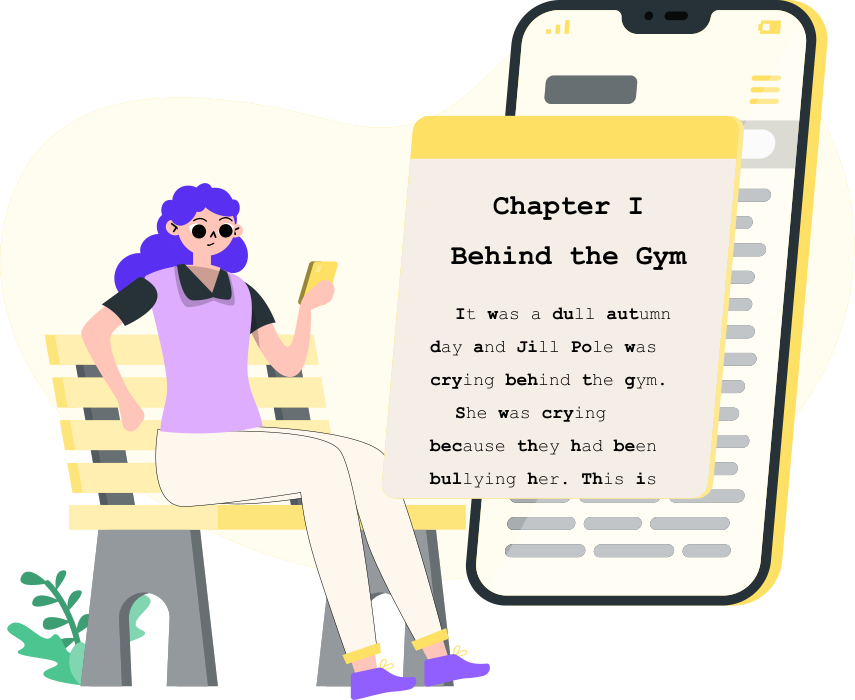
If losing your place mid-paragraph is what brought you here, Celer’s moving highlight fixes exactly that.
Building Your Own Memory Toolkit
Start Small and Be Consistent
Attempting all five strategies at once is a reliable recipe for doing none of them by the second week. Pick one or two that appeal to you and run them consistently for a month, watching what works and what does not before you adjust anything. A common and effective pairing is spaced repetition for vocabulary and facts alongside the Feynman technique for anything conceptual. New habits take time to settle, so judge the results across several weeks rather than a single session. Be specific about when each one happens, too, because a strategy attached to an existing routine survives while a strategy you intend to use whenever you remember does not.
Environment and Mindset Still Matter
These techniques sit on top of the basics, and the basics still have to be in place underneath them. Cut the distractions before you begin, get comfortable enough that your body is not competing for attention, and take breaks before you are fried rather than after. Approach the material with curiosity instead of dread where you can, since dread narrows attention and burns the energy you were going to need. For the wider view of reading with ADHD, our Ultimate Guide to Reading with ADHD works through the wider set of strategies, from school-age readers to adults carrying a full workload.
Executive function underpins all of it, the reading and the remembering alike, which is why the same few skills keep reappearing in every section above. As noted in discussions of ADHD and reading struggles, planning your reading, organizing what you find and monitoring your own understanding are what make the difference between an hour spent and an hour that paid.
From Understanding to Keeping
Improving retention with ADHD has nothing to do with fixing your brain, and everything to do with using methods that suit how it already works. Spaced repetition, elaboration, mnemonics, the Feynman technique and multi-sensory review all perform the same underlying job in different clothes, since each one forces a second and genuinely active pass over material that would otherwise receive one passive glance before disappearing.
Expect a certain amount of experimenting before anything settles. Pick one strategy and use it this week on something you actually need to remember, then notice how it feels and, more importantly, what you can still recall seven days later. Over a few months you end up holding a toolkit built specifically around you, and reading stops being something that passes through on its way elsewhere. It starts leaving something behind.
Try Celer free on iPhone and iPad

⭐️⭐️⭐️⭐️⭐️
"The only time I’m excited to read is with your app."
Dorcas
Related articles
Your Top Questions About ADHD and Reading, Answered
Direct answers to the questions that come up most, plus the myths that keep getting repeated.
Why ADHD Makes Reading Harder: The Brain Science
Working memory, inhibition and processing speed shape how the ADHD brain handles text. Here is the science behind the struggle, in plain language.
Executive Functions and Reading: A Deep Dive for ADHD
Five executive functions do the work of reading. This is what happens to decoding, fluency and comprehension when each one falls short, and why the fix has to match the function.