Choose reading mode (more settings inside the app)
Practical accommodations and teaching moves for educators supporting students with ADHD through reading.
Students with ADHD read better when the task is broken into short, clearly bounded pieces, when they have some genuine choice over the material, and when movement is built into the lesson rather than fought against for forty minutes. Those three moves cost nothing, require no new curriculum and change the shape of most reading blocks within a couple of weeks. Everything below expands on them into ten strategies you can put into practice this week, covering how you structure assignments, how you set up the room, which assistive technology is worth the setup time, and how you talk to families about what is happening at school.
You have almost certainly seen the pattern already: a bright student who can talk knowledgeably about almost anything, stuck on a single page and going nowhere for twenty minutes. Reading demands exactly what ADHD makes hardest to supply, which is sustained, low-stimulation attention held steady while several other mental jobs run underneath it. An inclusive reading setup helps every student in the room, and for students with ADHD it often decides whether the lesson works at all. Here is how to build one.

What Makes Reading Hard for These Students
The Executive Function Problem
Most reading trouble in ADHD traces back to executive function. These cognitive skills cover working memory, organization and sustained attention, and decoding text while tracking its meaning needs all three of them running at the same time. Add the physical side of the task, since sitting still and looking at a page for twenty minutes is a demand in its own right, and the difficulty stacks up faster than the reading level alone would predict. Knowing how the ADHD brain handles information is where genuinely useful teaching starts.
In the classroom the effect is specific rather than general. Inattention shows up as skipped words and skipped lines, a lost place on the page, or a narrative thread that comes apart halfway through the chapter. Hyperactivity shows up as fidgeting or as a student out of their seat for the third time. Impulsivity shows up as racing to the end of a passage without taking anything in along the way. None of this says anything about intelligence, since it is neurology, and neurology responds well to teaching that was designed with it in mind.
Ten Strategies That Work
None of the strategies below require new curriculum, extra budget or specialist training. Pick two or three to begin with, use them long enough to see whether they change anything, and add more once the first ones have settled into the routine.
1. Match Reading to the Individual Student
Differentiation matters more in reading than almost anywhere else in the timetable, so offer a genuine spread of text types, genres and topics that connect to what your students actually care about. Graphic novels count, and so do high-interest non-fiction articles and interactive digital stories, all of which can sit alongside the traditional texts rather than replacing them. Flexible grouping then lets you aim support at small clusters of students according to what they need this month rather than what they needed back in September.
Say a student is obsessed with space. Let them read a slightly easier book about space and build fluency and confidence on material they genuinely want to finish, while another student takes on something harder with scaffolding in place. Even inside a fixed curriculum theme, offering a choice between three texts instead of assigning one lifts motivation noticeably, and the choice does not have to be wide to do its work. Two or three options that all meet the same objective are enough, because what changes is the student's sense that they picked this rather than had it handed to them. For deeper differentiation techniques, Reading Rockets has strong material for teachers.
2. Structure Assignments Clearly
Students with ADHD do well with predictability and sharply defined expectations, so break long or complex reading into smaller chunks that have obvious boundaries. Keep the instructions short and concrete, and back them with a visual checklist or a simple graphic cue so that a student can check what they are meant to be doing without having to ask you a second time in front of the class.
Colored paper for particular tasks, or highlighted key sections, gives attention something to land on when it starts to slide. Compare two versions of the same instruction and the difference becomes obvious: 'Read Chapter 3' is vague and easy to drift out of, while 'Read pages 20 to 22 and find three facts about why the main character decides to leave' is a task with a visible end. For longer texts, hand out a short outline or a fill-in-the-blank graphic organizer to complete while reading, which keeps overwhelm down and gives the student a route through the material. The organizer also gives you something concrete to look at afterwards, so you can see where comprehension held and where it dropped away rather than guessing from a blank expression.
3. Set Up the Room for Focus
The physical space does more work than most people expect it to, so cut the visual clutter and cut the noise wherever the building allows. Offer seating options as well: a standing desk, a wobble cushion for students who need to move while they think, a beanbag in a quiet reading corner away from the traffic. Letting students choose where they sit lets them find the setup in which their body settles enough for their brain to get on with the reading.
Placement matters just as much as furniture. Keep students with ADHD away from the door, from busy group tables and from the pencil sharpener if movement and noise reliably pull their attention across the room. Noise-reducing headphones during independent reading are a small accommodation with an outsized effect on how much gets read. A calm, organized and predictable room gives concentration somewhere to happen, and the benefit carries well beyond the reading block. It is also worth asking students where they think they focus best, since they usually know, and their answer tends to be cheaper to act on than anything you would have guessed.
4. Use Simple Assistive Technology
Assistive technology does not need to be expensive or complicated to earn its place in a classroom, and text-to-speech is the obvious starting point because it is already built into most devices. It helps students who struggle with decoding, who read slowly, or who tire out after a few minutes, since hearing the words while following the text on screen takes a substantial chunk of the load off the reader.
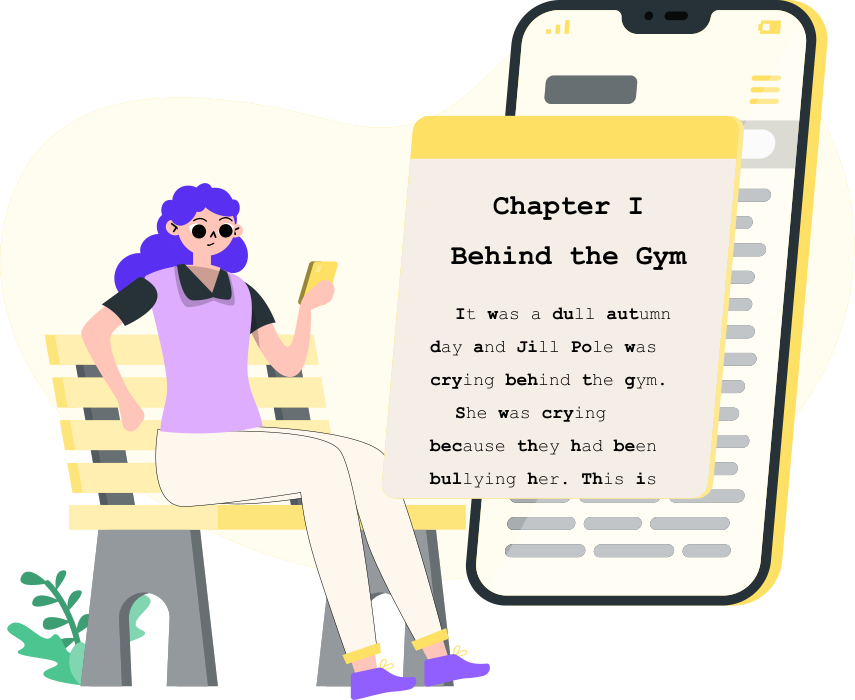
Audiobooks do similar work, and they matter most for giving a student access to grade-level content and complex stories they could not yet decode on their own. Beyond those two, digital highlighters, visual timers such as the Time Timer, and focus apps or browser extensions all have a role to play in a normal week. A student might listen through a hard chapter with text-to-speech, then go back through it with a digital highlighter to mark the vocabulary that mattered. For the reading itself on a school iPad, an app such as Celer lets each student set their own font, text size and background contrast, which quietly removes an obstacle you would otherwise never see them hit. Understood.org has more ideas on assistive technology for reading.
5. Keep Reading Activities Interactive
Whole-class reading needs participation built into its structure rather than bolted on at the end. Choral reading gets everyone's voice going at once, partner reading has students trading turns every paragraph, and acting out a scene or running reader's theater brings bodies into the text. Short comprehension questions dropped in frequently check understanding and, just as usefully, keep attention from drifting during the gaps. Aim to change the activity roughly every ten minutes rather than running one long reading block.
Small groups are where the targeted work actually happens. Use guided reading with regular check-ins so that you catch a misunderstanding while it is still small and the feedback lands immediately rather than a week later. Peer tutoring works well too, provided the structure behind it is real: make the task explicit and give each student in the group a defined role, or the confident readers will quietly do everything while the others watch.
For independent reading, choice is the lever that moves the most, so let students pick material they are genuinely interested in wherever the curriculum leaves room. Build in short movement breaks so they can reset before attention runs out entirely, and suggest reading in bursts of ten to fifteen minutes with each burst followed by a quick check-in, a short discussion or a small related task. Most reading strategies for children with ADHD come back to the same three ingredients: choice, novelty and frequent breaks.
6. Build In Movement and Sensory Input
Plenty of students with ADHD learn through their bodies, and movement supports the reading rather than competing with it. Allow wiggle breaks between tasks, and then put physical action inside the reading itself: students stand and stretch when a keyword comes up in the story, or new vocabulary gets acted out with a gesture the class invents together. Energy that was going to come out one way or another now has somewhere useful to go.
Keep fidget tools available and deliberately low-key, whether that means stress balls, bendable wax sticks or a textured strip taped under the desk. Used quietly they support self-regulation without pulling the rest of the room's attention across. If the space allows it, some students read better standing at a raised desk or pacing in a corner with the book in one hand. Working with the need to move, rather than suppressing it, generally buys more focus than insisting on stillness ever does. Set the boundaries clearly at the start so the class knows that a fidget tool which turns into a toy goes back in the drawer, and then let students use them without further comment.
7. Be Clear About Expectations, and Reinforce Effort
Spell out what good reading work actually looks like in your room, because students who cannot picture the target rarely hit it. Visual schedules, step-by-step instruction cards and simple rubrics turn a vague expectation into something a student can check themselves against without your help. Break complex assignments into sequential steps and mark each step as it is completed, so that progress stays visible while the task is still underway rather than only at the end.
Then be careful about what you reinforce, praising effort and progress specifically instead of praising outcomes. Saying 'I noticed you stayed with that hard paragraph all the way through' tells the student exactly what they did well and exactly what to repeat tomorrow, whereas 'good job' tells them almost nothing they can use. A simple and visibly fair reward system for meeting reading goals works well, as long as what it rewards is persistence and participation rather than raw performance, which some students cannot yet control.

8. Grow a Growth Mindset Around Reading
Many of these students arrive carrying years of reading failure with them, and somewhere along the way they quietly concluded that they are simply bad at it. That conclusion is worth pushing back on directly and repeatedly. Reading skill grows with practice and effort, and students need to hear that said plainly and then see it confirmed in their own progress over a term. Treat a hard text as something to work at rather than as evidence about who the student is.
Share age-appropriate stories of people who struggled with reading and got somewhere anyway, and make a visible thing of small improvements when they happen. When a student hits a wall on a passage, reframe it out loud with something like 'this bit is tricky, let's try a different way in.' That framing builds resilience, lowers the anxiety that surrounds reading for so many of these students, and keeps them trying when the text pushes back. Say it consistently for long enough and it eventually becomes the student's own internal voice, which is the real point of the exercise.
9. Set Reading Goals Together
Bring students into the work of setting their own reading goals, because a goal a student helped choose is a goal they own, and ownership does more for motivation than any chart on the wall. Keep the goals small and easy to check against. Stamina goals work well, such as reading with focus for seven minutes without stopping, and so do comprehension goals, such as finding the main idea and two supporting details in a section, or simply trying out a strategy you taught the previous week.
Give students a straightforward way to see their own progress, whether that is a chart, a journal or a digital tracker they update themselves. Then review the goals together in short one-to-one conferences, marking what went well and adjusting whatever did not. Those few minutes turn a student from someone the reading happens to into a partner in it, which is often the single biggest shift available to you.
10. Keep Parents in the Loop
Talk to parents and guardians regularly, and not only on the occasions when something has gone wrong. Tell them which strategies you are using in class so that the same approach can carry over at home instead of being reinvented there. Share progress, name the successes out loud, and raise emerging difficulties as something to solve together rather than as a complaint to be answered. When home and school pull in the same direction, the student receives one consistent message instead of two competing ones.
Give parents concrete things they can do, since good intentions rarely survive a busy evening without a plan. A regular family reading time helps, as does reading aloud together, which is worth continuing well past the age at which most families stop. Talking about books and articles at the dinner table as ordinary conversation does more than it appears to. You can also point families toward material from organizations such as ADDitude Magazine for parents. A working home-school partnership underpins everything else on this list.

If losing your place mid-paragraph is what brought you here, Celer’s moving highlight fixes exactly that.
Putting It Together
There is no single technique that fixes reading for students with ADHD, and anyone selling one is overstating their case. What works is layering, which means structure plus choice plus movement plus feedback, applied consistently across a term rather than tried once in a difficult week. Learn how each student is actually wired, apply the strategies above with some patience, and you end up with a room where attention differences stop being the thing that decides who gets to be a reader.
Quick Recap: Core Principles for ADHD Reading Success
⏵
Patience is Paramount: Progress comes slowly and unevenly, so mark the small wins out loud, because those are the ones the student can actually see happening.
⏵
Flexibility is Key: What works in October may stop working by March, so expect to adapt your strategies as students grow and their demands change.
⏵
Collaboration Amplifies Impact: Pull in students, parents and specialist colleagues, since support that runs in only one direction rarely holds together for long.
⏵
Focus on Strengths: Start from what the student can already do well, because confidence built there tends to carry into the parts they cannot manage yet.
Consistency, patience and a genuinely positive stance are the tools that matter most here, and none of them appear anywhere in a curriculum document. Every student's route into reading is different, and your willingness to adapt is what stands between a student who gives up in November and one who keeps going. For a fuller picture of supporting readers with ADHD, the Ultimate Guide to Reading with ADHD has more strategies and resources to draw on. Keep testing what works for the students in front of you.
Try Celer free on iPhone and iPad

⭐️⭐️⭐️⭐️⭐️
"The only time I’m excited to read is with your app."
Dorcas
Related articles
The Power of Reading Aloud for Children with ADHD
A guide for parents and teachers: what reading aloud does for a child with ADHD, and how to run sessions they look forward to.
Breaking Down Books: Chunking for ADHD Children
How to split reading into pieces small enough that your child finishes them, and why that changes everything about how they feel afterwards.
Optimizing Reading Spaces for Children with ADHD
How to build reading spaces at home and at school that support focus instead of competing with it