Choose reading mode (more settings inside the app)
How to build reading spaces at home and at school that support focus instead of competing with it
A reading space that works for a child with ADHD comes down to five things you can control: warm and steady light that does not flicker, noise kept as low as the household allows, surfaces with almost nothing on them, seating that permits some movement rather than demanding stillness, and one or two sensory tools for children who genuinely settle with them. Get all five roughly right and a surprising amount of the daily struggle over reading dissolves without anybody having to be firmer about it, because the child is no longer fighting the room before they reach the first sentence.
The reason this matters so much is straightforward: for a child with ADHD the room is competing with the book for attention, and left to itself the room usually wins. This guide walks through each of the five elements in turn, first at home and then in the classroom, since the two settings offer very different amounts of freedom. The aim throughout is a space that quietly pulls attention toward the page rather than away from it.
Why the Room Matters So Much
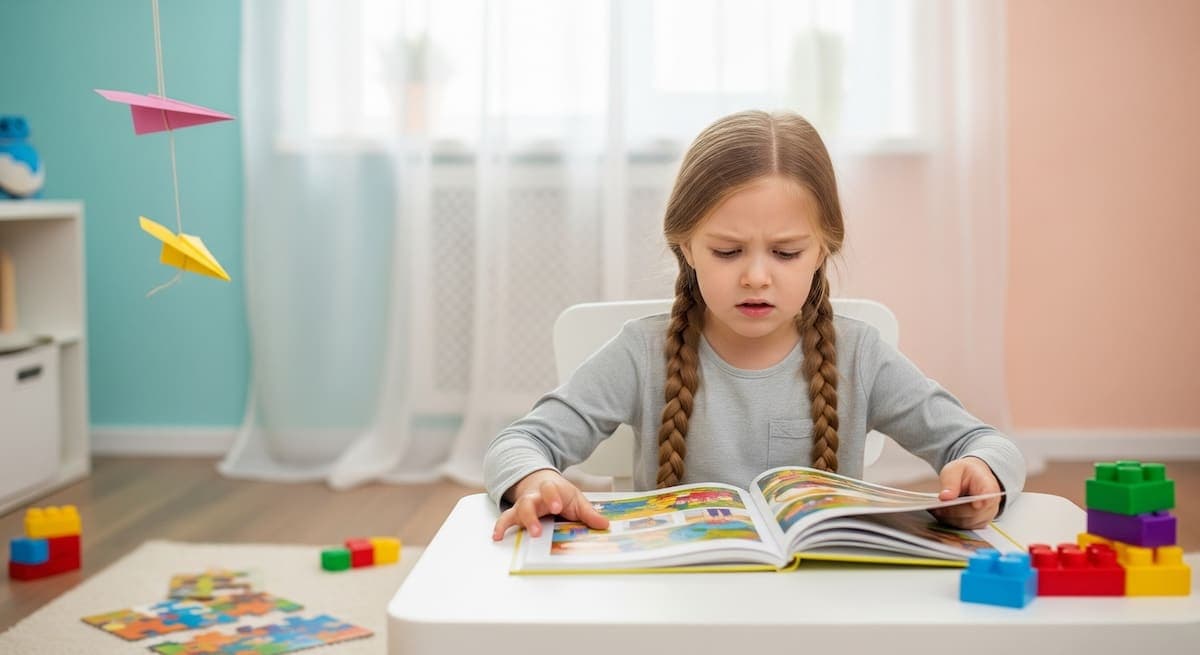
Children with ADHD take in their surroundings at a higher volume than other children do, which means a flickering bulb or a conversation two rooms away is not background noise for them but something closer to foreground. Focus goes, and getting it back takes real effort that then is not available for the reading itself. None of this is weak willpower on the child's part. It is how their brain filters incoming information, and sustained attention happens to be the first thing that gives way under the load.
That is why a quiet, low-stimulation reading space is not a pleasant extra to arrange when there is time. It removes obstacles the child would otherwise have to climb over before reading a single word, which is a much better use of their limited attention. Knowing how the ADHD brain approaches reading fills in more of the picture behind that, and Medical News Today covers the underlying reading difficulties in detail.
The Five Elements
1. Lighting
Light either supports concentration or quietly erodes it, and there is very little middle ground over the course of half an hour. For a child with ADHD, the wrong light acts as a low-level irritation running underneath the entire reading session. Natural daylight is usually the best option available, so put the reading area near a window and hang sheer curtains to soften the light and stop glare from bouncing off the page into their eyes.
When there is not much daylight to work with, which covers most winter evenings, aim for warm and steady artificial light instead. Skip fluorescent tubes wherever you can, since the flicker and the faint hum are agitating even when nobody in the room consciously notices either of them. Warm white LED bulbs work considerably better, and dimmable ones let you match the light to the time of day rather than lighting a bedtime story like a kitchen.
Add task lighting on top of the general lighting by aiming an adjustable desk lamp directly at the book. The page then becomes the brightest thing in the room while everything else falls away into dimness, which does a share of the attention work on the child's behalf. It is a small and cheap change, and it shifts where the eyes naturally travel when concentration starts to loosen.
2. Noise
Sound is the single biggest distraction for most children with ADHD, which makes getting the noise down more valuable than anything else on this list. Even a small unexpected sound breaks the thread of the story, and that thread may have taken several minutes to build in the first place, with rebuilding it costing roughly the same again.
At home, pick the quietest room you have even if it is not the room you had in mind, since a spare corner away from the kitchen beats a beautifully arranged desk beside it. Noise-canceling headphones make a real difference when genuine quiet is unavailable, which in most family homes it is. Some children settle better with white noise or soft nature sounds playing underneath, because a steady background masks the unpredictable sounds that would otherwise grab them mid-sentence.
In classrooms, dividers help a great deal, and so do soft furnishings such as rugs and curtains that absorb sound and kill the echo that hard surfaces create. As Understood.org points out, noise sensitivity is common with ADHD, so it is worth testing what actually works for the individual child rather than applying one policy. For some of them the answer is near-silence, while for others it turns out to be quiet instrumental music with no lyrics for the language system to follow.
3. Clutter
Visual clutter overloads a child with ADHD quickly, and an overloaded child cannot hold their focus on a page for long. A tidy space brings the sensory input back down to something manageable before the reading even starts. The governing rule here is simplicity, and it applies rather more strictly than most parents expect it to when they first try it.
Clear the reading area first, taking out anything not connected to reading: the toys, the gadgets, the spare decorations and the half-finished project sitting on the corner of the desk. What you are aiming for is a space that looks calm at a single glance, because that first glance is what the child's attention responds to when they sit down.
Then give everything that remains a home of its own. Bins, baskets, shelves and drawers all work well, and closed storage works best of all because what the child cannot see does not pull at them while they read. Keep books on one neat shelf or in a single reading basket so that the selection feels inviting rather than endless and slightly daunting. A structured space also props up the executive function skills that ADHD leaves running short.
⏵
Tidy Book Storage One shelf or bin holding a small rotating selection rather than every book they own, so choosing takes seconds instead of minutes.
⏵
Clear Reading Surface Nothing on the surface except what the current book actually needs, which is usually the book and very little else.
⏵
Calm Decor Simple colors and quiet wall art near the reading spot, since busy patterns keep pulling the eye back toward the wall.
⏵
Contained Tools Pens and reading tools stay put away in a box or drawer and come out only at the moment they are being used.

4. Seating
Sitting still for long stretches is genuinely hard for many children with ADHD, and a rigid chair effectively turns reading into two tasks running at once, one of which is staying in the chair. Flexible seating removes that second task and gives the whole of the child's attention back to the book.
Offer seating that allows small movements to happen without comment. Beanbags, floor cushions, large pillows and even a small tent all beat a standard chair for this purpose, and active seating such as a wobble stool suits some children particularly well. The gentle movement gives the body something to occupy itself with, which frees the mind to attend to the book rather than to the growing urge to get up.
Let them change position during a session too, so that sitting, lying down, standing at a high table or working with a lap desk are all treated as options rather than as concessions granted reluctantly. The aim is to take physical restlessness out of the equation entirely so that it stops competing with the story for the child's attention. Most reading strategies for children with ADHD build in movement for the same underlying reason. Comfort here is not indulgence, it is a precondition for reading happening at all.
5. Sensory Tools
Sensory needs vary widely with ADHD, since some children are seeking input almost constantly while others are doing their best to escape it. The right tools in the reading space help a child regulate themselves, stay calm and stay inside the book for longer, and the wrong ones become one more thing to manage.
Deep pressure works for a lot of children, so a weighted lap pad or a snug vest is worth trying early. Textured cushions or a soft blanket provide steady tactile input without asking for any attention, and quiet fidget tools such as a stress ball or putty keep the hands busy, which often means a mind that stays on the page. Two conditions apply to any of these: the tool has to be silent, and it must not need to be looked at while it is being used.
Watch the child and learn their actual preferences rather than assuming them, because what calms one child winds another one up within minutes. Introduce tools one at a time and see what happens over a week, aiming for just enough sensory input to meet the need without creating a new distraction in the process. Reading Rockets has advice on building positive reading experiences, sensory side included. Mild calming scents and a comfortable room temperature belong in the same category of small adjustments that cost almost nothing to test.
If losing your place mid-paragraph is what brought you here, Celer’s moving highlight fixes exactly that.
Home and Classroom Are Different
At Home
Home gives you freedom that a classroom never will, so it is worth using rather than defaulting to a desk in a bedroom. Bring the child into designing the space with you, because a child who chose the cushion and decided where the lamp should go will actually use the corner. A child who was simply assigned a reading spot tends not to, however carefully you set it up for them.
It does not need to be a whole room, either, since a corner of the bedroom works perfectly well, as does a pop-up tent in the living room or a beanbag tucked under a loft bed. What matters is that the space is always there and that it always means reading, which is what allows it to start working automatically after a few weeks of use. The signal is doing part of the job that willpower would otherwise have to do.
Stock it with the seating they like, decent lighting and whichever sensory tools have earned their place through actual use rather than good intentions. Then keep it tidy and keep it for reading only. The moment it becomes the time-out spot or a general dumping ground for laundry, it stops being a retreat and the association you spent weeks building quietly disappears.
In the Classroom
Teachers are setting the conditions for a whole room at once, which is harder to do and correspondingly higher leverage when it works. A designated quiet reading zone helps students with ADHD and a good number of their classmates besides, and it can be built on exactly the same principles as a home corner: good light, low noise and visual calm within the child's field of view.
Put a few seating options inside the zone, such as floor cushions, beanbags or a standing desk if the room can spare the floor space. Study carrels or partitions cut visual distraction for the individual students who need them most, and focus tents and under-table nooks sound gimmicky while working surprisingly well in practice, because a sense of enclosure settles some children almost immediately.
A visual schedule signals clearly when quiet reading time begins, which removes the ambiguity that trips students up more often than the reading itself does. Be explicit about how the zone is meant to be used as well, since unspoken rules are reliably the ones that get broken first. BehaviourHelp covers differentiating instruction, and the same thinking applies just as well to the environment. Talk to parents too, because support at home is usually what makes a school strategy stick.

Keeping It Working
A reading space is something you maintain rather than something you finish on a Saturday afternoon. What keeps it useful over a year is watching how it actually gets used and changing it as soon as it stops fitting the child. The goal underneath every adjustment is focus in the short term and, further out, a child who genuinely likes reading rather than one who merely complies with it.
Keep asking the child what they think about it, starting with what feels comfortable and what helps them concentrate. Their answers are usually more accurate than your guesses, sometimes startlingly so, and the act of being asked gives them a sense of ownership over the space instead of a set of rules attached to it.
Watch closely as well as asking, since children do not always report what they do. Is the light still right for the season? Is that fidget toy helping, or has it quietly become the main event? Are they even using the corner, or has it turned into somewhere the schoolbag lands? Change things when the evidence points that way, because a child's needs shift as they grow, and a setup that worked beautifully last year may be part of why reading stalled this year.
Consistency and encouragement do most of the remaining work. Notice when they use the space and say so out loud, and keep the associations positive so that the corner always means stories and calm and never punishment. CHADD has extensive resources on positive behavioral supports that reinforce the same approach from a different angle.
⏵
Child's Voice Ask them regularly about the space: what helps, what gets in the way, and what they would change if it were entirely up to them.
⏵
Adapt and Evolve Expect to rearrange it more than once, since preferences shift as children grow and a fixed setup goes stale surprisingly fast.
⏵
Positive Vibes Only Tie the space to enjoyment from the beginning, starting with shared reading or audiobooks there to build the association.
⏵
Empower with Choice Offer choices inside the space, whether that is which sensory tool to use, which spot to sit in or which book to open first.
A Foundation for Reading
Setting up a reading space for a child with ADHD is not a decorating project, whatever it looks like from the outside. It is the work of removing the obstacles between the child and the page one at a time, and light, noise, clutter, seating and sensory input are the five that account for most of them. Fix any one of them and you save the child a measurable amount of effort. Fix all five and that saved effort goes straight into the book instead.
The effect tends to show up as less frustration at the start of a session and more confidence by the end of it, which is what literacy is genuinely built on over the years. Progress will be gradual rather than dramatic, so keep the changes in place long enough to see whether they are working instead of rearranging the corner every week in search of a faster result.
Every child should get the chance to disappear into a story for an hour, and a well-built space is how you hand them that chance rather than hoping it arrives on its own. For the wider picture on supporting readers with ADHD, our Ultimate Guide to Reading with ADHD covers strategies, tools and approaches in considerably more depth.
Try Celer free on iPhone and iPad

⭐️⭐️⭐️⭐️⭐️
"The only time I’m excited to read is with your app."
Dorcas
Related articles
Visual Aids for ADHD Reading: Graphic Organizers & More
Six graphic organizers, what each one is for, and the practical tips that decide whether they help or just add another blank page to fill in.
Reading Together: How to Share a Book with a Child Who Has ADHD
The session itself rather than the surrounding advice: how long to sit, who reads what, and what to do in the moments when it starts going wrong.
Reading for Tests: ADHD Strategies for Academic Success
How to get through dense study material with ADHD, and how to read exam questions without losing marks to impulsivity.