Choose reading mode (more settings inside the app)
How listening removes the parts of reading that ADHD makes hardest, what the research says about comprehension, and how to choose a book you will actually finish.
Audiobooks are better for a great many people with ADHD, because they remove the two demands that make print expensive: holding your eyes steadily on a line of text, and facing down a page that looks like a wall before you have read a word of it. A narrator carries the pace for you, so your attention always has something moving to hold onto, and you still get the entire book, argument for argument and scene for scene, delivered through your ears instead of your eyes. That will not be true for everyone, and it is a poor fit for some kinds of text such as equations or anything you need to flip back through constantly, but it deserves a proper trial before you conclude that reading is simply not something you do.

What follows covers three things: why listening suits the way an ADHD brain takes in information, whether audiobooks genuinely count as reading when learning and comprehension are what you are after, and the practical habits that turn sound playing in the background into a book you can still describe a week later.
Understanding the Reading Hurdle with ADHD
It is worth knowing exactly why print is hard before you decide what to replace it with, because the reason shapes the fix. None of this is about intelligence, and none of it is about wanting it badly enough. It comes down to the way an ADHD brain handles a stream of incoming information that arrives all at once and expects to be sorted in real time.
Why Traditional Reading Can Be Tricky
ADHD affects executive function, and these functions are the ones that hold focus, screen out distractions and keep information alive in working memory. Reading leans on all three in the same instant, which is why a dense page arrives as too much at once rather than as a sequence of manageable sentences. Your eyes travel across the words while your mind slides off the meaning behind them, and you finish the paragraph having read it three times without gaining anything from any of the passes.
The complaints are consistent from one person to the next: attention runs out partway through a long passage, either outside noise or your own thoughts pull you away at the worst moment, and your eyes lose the line you were on and land two lines below it. Reading turns into work you quietly dread instead of something you look forward to, and dreaded work has a way of not getting done at all. Our Ultimate Guide to Reading with ADHD takes each of these apart in more detail.
The Audiobook Advantage: A New Chapter for ADHD Readers
So what actually changes when a book is spoken rather than printed? Several things change at once, and each of them lands on one of the problems described above rather than on reading in general, which is why the effect can be so noticeable so quickly.
Tuning In: How Audiobooks Capture Attention
Sound holds attention in a way that motionless text on a page never quite manages. A skilled narrator shifts tone, varies pace and gives each character a distinct voice, so your brain keeps receiving something new to react to instead of being asked to generate its own interest. There is also a pacing effect worth noticing on its own: the story keeps moving whether or not you are gripping every sentence, so when your mind wanders you rejoin a narrative already in motion rather than a page that stalled the moment you left it. The voice works as an anchor, and one stray thought no longer ends the session.
Listening also costs far less visual effort, since nothing has to be tracked across a line or decoded letter by letter. That frees up mental room for the content itself, and it leaves you noticeably less drained at the end of an hour, which is often the difference between coming back tomorrow and not.
Beyond the Page: Accessibility and Reduced Overwhelm
If large blocks of text overwhelm you visually, or if decoding words is slow and effortful, audio removes that barrier outright rather than softening it. There is no intimidating page to face down; there is a voice, and you follow it. Starting becomes much easier as a result, and starting is usually the hardest part of the whole business. The gain is larger still when dyslexia sits alongside ADHD, and text-to-speech tools for ADHD apply the same principle to anything you can put on a screen.
Audio also fits into the gaps in a day that print can never occupy. You can listen while you commute, wash up, fold laundry or walk the dog, and for many people that light physical activity sharpens focus rather than splitting it, because the restless part of you finally has something to do. Reading stops being an event you have to sit down and brace for and becomes something that runs alongside what you were doing anyway.
Rediscovering the Joy of Stories
The largest thing audiobooks hand back is the pleasure. Once the mechanical fight is out of the way you can sink into a plot, care what happens to a character and follow an idea somewhere you did not expect it to go. Plenty of adults with ADHD spent years assuming they simply did not like books, when what they did not like was the labor of decoding them one line at a time. Take that away and the enjoyment turns out to have been sitting underneath it the whole time, which changes both what you read and how much of it you get through.
The shift does something for your confidence as well, because finishing a whole book is direct evidence that the format was the obstacle rather than you, and that evidence tends to outlast whatever story you had been telling yourself.
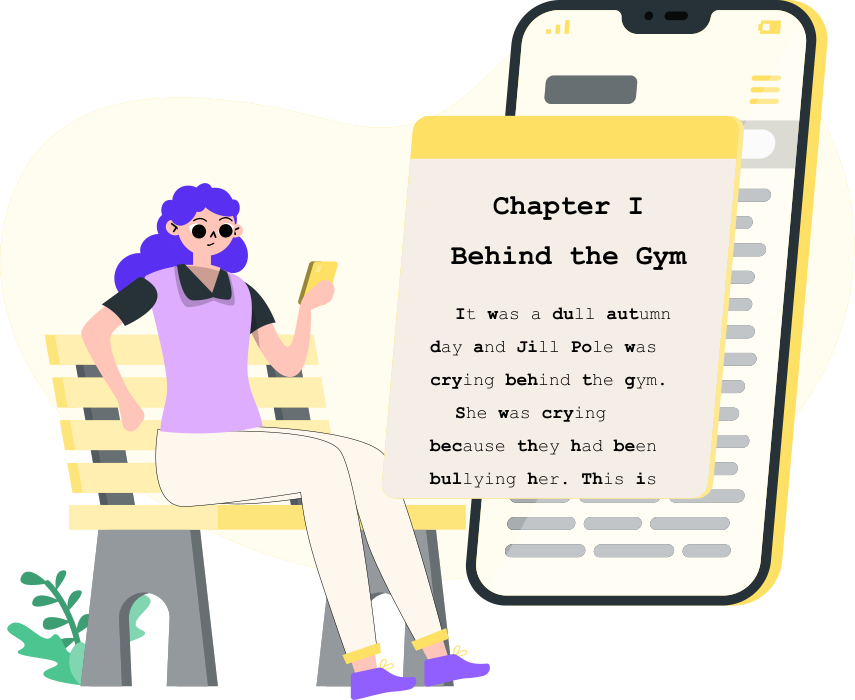
If losing your place mid-paragraph is what brought you here, Celer’s moving highlight fixes exactly that.
Audiobooks and Learning: Does Listening 'Count'?
People ask this constantly, and usually with a little guilt attached, as though listening were a way of getting the credit without doing the work. The question deserves a serious answer rather than a reassuring one, so it is worth looking at what comprehension actually requires.
Comprehension and Connection: The Power of Auditory Learning
It counts. Comprehension means understanding ideas and holding onto them, and the route those ideas travel to reach you does not alter either half of that. Auditory processing is frequently a relative strength for people with ADHD, so a well-narrated book can leave you understanding more than the printed edition would have, precisely because it skips the visual and attentional hurdles that were eating the effort. Research suggests the brain treats read and heard information in much the same way, drawing on many of the same regions.
The purpose of reading is to take meaning out of something and then do something with it, whether that means using an idea at work, arguing with it, or simply being moved by it. Audiobooks deliver all of that, on one condition: you have to be genuinely attending to the words rather than letting them run as pleasant noise while your mind is elsewhere.
Building Vocabulary and Knowledge, One Listen at a Time
Audiobooks build vocabulary particularly well, because hearing an unfamiliar word pronounced properly inside a sentence that supplies its meaning teaches it more reliably than meeting the same word silently on a page and guessing. Beyond individual words, listening widely exposes you to new arguments, unfamiliar styles and subjects you would never have picked up in print, exactly as reading does. Choosing audio is not a downgrade or a shortcut. It is a different road to the same destination, and for many people it is a considerably faster one.
Active Listening Strategies for ADHD Minds
Audiobooks do a lot of work on their own, but a handful of deliberate habits push focus and recall a great deal higher than the format manages by itself. The whole aim is to listen actively, in the sense of doing something with the material as it arrives, rather than allowing sound to happen somewhere near you while your attention quietly goes elsewhere.
Maximizing Focus and Retaining Information
How much you keep from a book depends less on the book than on what you are doing while it plays, which is good news, because that part is under your control. Small adjustments compound quickly across a long title. Some listeners prefer dedicated apps such as Speechify for ADHD reading for their finer speed controls and other listening features.
⏵
Adjust Playback Speed: Try 1.25x or 1.5x, since a quicker pace leaves less room for your mind to slip away between sentences and many ADHD listeners find it markedly easier to stay with. Nudge the speed up until comprehension starts to suffer, then come back one notch and settle there.
⏵
Use Headphones: Headphones close out the room and place the narrator's voice directly in your head, and with fewer competing sounds around you there is far less work involved in staying with the story.
⏵
Take Notes or Doodle: Jot down names, turning points or a phrase that struck you, and count doodling as a legitimate version of the same thing. Busy hands stop restlessness from escalating into an abandoned session.
⏵
Discuss the Book: Tell somebody what happened, whether that is a friend, your partner or a book club, because putting the material into your own words is the step that fixes it in memory.
⏵
Listen in Chunks: Aim for twenty or thirty minutes and then stop for a while, since short deliberate sessions beat marathon ones where the final hour goes in one ear and straight out the other.
⏵
Minimize Other Distractions: Light repetitive activity is fine and often helps, but anything that demands real thinking will compete with the narration for the same resources and you will end up losing both.
Pairing a book with walking, knitting, coloring or tidying works well for a great many people. The trick is choosing a task automatic enough that it steals nothing from the audio, yet active enough to absorb the fidgeting that would otherwise pull you out of the chapter.
Choosing Your Next Listen: A Guide for ADHD Readers
The book you choose matters as much as the format you choose it in. A poor match will lose you inside an hour, and it is very easy to read that hour as proof that audiobooks do not work for you when it was only ever evidence about one title and one narrator.
Key Factors for an Engaging Audiobook Experience
Match the book both to what genuinely holds your interest and to how long your attention realistically lasts, paying particular attention to the narrator, the genre and the way the text is broken up. Platforms such as Audible and Libby let you play a sample before committing, which is the quickest way to test all three at once.
⏵
The Narrator Matters: The narrator decides almost everything about the experience, so look for a clear voice, a lively delivery and a pace that suits you. Play the sample and trust your first reaction, because a voice that grates on you in five minutes will not grow on you across fourteen hours.
⏵
Genre Gold: Choose something with genuine pull, since thrillers, mysteries, science fiction, fantasy and comedy tend to hold attention through their own momentum. Non-fiction works just as well when the subject is something you already care about.
⏵
Consider Length and Structure: Start small, because a novella or a collection of short stories is far less daunting than a twenty-hour epic, and short chapters with clear breaks hand you natural places to stop without losing your footing.
⏵
Look for High Engagement Factors: Full-cast recordings, sound effects and music add texture that a single reading voice cannot, and the more that is happening in your ears the fewer gaps there are for your attention to slip through.
⏵
Follow Recommendations: Seek out lists assembled specifically for ADHD listeners, or browse somewhere like ADDitude Magazine when you want ideas rather than an algorithm.
Give any book a fair hearing, then abandon it without guilt if it still is not working, because you owe a book nothing beyond the trial you already gave it. The point of all this is to enjoy the thing, and there are thousands more waiting behind the one that disappointed you.
Beyond Audiobooks: Exploring Other Reading Supports
Audiobooks are one tool rather than the whole set, and most people get their best results by mixing a few approaches instead of betting everything on a single one that then has to work in every situation.
A Multi-Tool Approach to Reading with ADHD
If you want to keep reading text directly alongside your listening, there is plenty of technology that helps you do it. Our guide to ADHD reading tech tools covers the software and devices built to make text less costly to get through, including apps that read digital documents out loud and readers that highlight each line as the voice reaches it.
Structured reading programs, visual aids and a space cleared of distractions all pull in the same direction as audio does, and they combine well. The Ultimate Guide to Reading with ADHD gathers what works for adults, for students and for younger readers into one place. Expect to try several before one of them sticks, because that is how this normally goes rather than a sign you are doing it wrong.
Conclusion: Embrace the Power of Listening
Are audiobooks better for ADHD? For a large number of people the answer is plainly yes, because they route around the parts of reading that ADHD makes hardest while leaving the comprehension, the learning and the pleasure entirely intact. Something that used to feel like a slog becomes something you can do on a walk with the dog, and a whole area of life that had quietly closed reopens without much ceremony.
If print has been a fight for you or for someone close to you, give audiobooks a month of honest effort and see what happens. Sample a few genres, a few narrators and a few listening speeds before you judge the format, since the first combination you try is rarely the best one available. There is a fair chance that listening turns out to be the version of reading that finally works for you, and there are more books waiting than you could finish in a lifetime. Where a book only exists in print or as a PDF, keeping a reader such as Celer on your iPhone or iPad covers the gap, since adjustable themes and fonts make the pages you do still have to look at considerably less punishing.
Try Celer free on iPhone and iPad

⭐️⭐️⭐️⭐️⭐️
"The only time I’m excited to read is with your app."
Dorcas
Related articles
Speechify for ADHD: A Game-Changer for Reading?
A close look at what Speechify does, where it helps an ADHD reader most, and whether the paid version earns its price.
A Bionic Reading Alternative for ADHD on iPhone and iPad
Celer is a cheaper, simpler iOS reading app built for focus. Here is how it compares to Bionic Reading for ADHD readers.
How Long Is a Reading Session? What 8,125 Sessions and 1,118 Readers Told Us
Six figures from Celer's own in-app analytics, each published with the number of sessions or answers behind it and the reason it should be read carefully.