Choose reading mode (more settings inside the app)
How to set up a space that stops working against you, covering the four kinds of distraction that break an ADHD reader's focus.
A distraction-free reading environment for ADHD comes down to fixing four things that break your focus, and all four are fixable: the phone in your pocket, the noise around you, the noise inside your own head, and physical discomfort you stopped consciously noticing months ago. Deal with them roughly in that order and reading gets dramatically easier without any additional willpower being required. If you have Attention-Deficit/Hyperactivity Disorder, you already know how fast a wandering mind or a single notification can end a session, but what is easy to miss is how much of that belongs to the room rather than to you. The sections below take each of the four in turn with specific changes to make, most of them free and most of them possible in an afternoon.
None of it has to be perfect in order to work, and you are not building a monastery. You are noticing what pulls you away from the page and removing it one item at a time, which is a much smaller job than it sounds. The details will look different for you than for anyone else, but the two aims stay the same throughout: less arriving at you from outside, and less churning away inside. Change one thing, read for a week, then change the next, because trying to fix everything in a single evening is its own kind of distraction.
Taming the Digital Beast: Managing Electronic Distractions
Start with your devices, since they outclass everything else for sheer pulling power and nothing else in the room was designed by a team whose job was to interrupt you. An ADHD brain finds that particular interruption very hard to decline. Fix this one first and the remaining three become noticeably easier, because you are no longer competing against something engineered specifically to win.
Why Digital Devices Derail Focus for ADHD Readers
Phones, computers and tablets exist partly to interrupt you, and every buzz and banner is built to succeed at it, knocking you out of the book each time one lands. Climbing back into what you were reading takes real effort, so a single glance costs you far more than the ten seconds it appeared to. The reason is chemical rather than moral: a notification pays out immediately while a book pays out slowly, and your brain reaches for the quick one. That is not weak willpower on your part but a system optimized to exploit exactly what ADHD makes harder to resist. Our Ultimate Guide to Reading with ADHD covers the wider picture.
There is a number worth sitting with here. Across 8,125 completed sessions logged in Celer's own reading app over the year to August 2026, the median session ran under 50 seconds, and 27% ended within ten seconds. That is not proof of what ended them: a 'session' in this data is any book opened and closed, so the shortest slice mixes real interruptions in with quick opens that were never a reading attempt at all, and nothing in the count says which is which. These are Celer's readers in general, too, not a group screened or asked about an ADHD diagnosis. What the shape does show is how little slack there is. Most sessions end well before a calm, unbroken stretch of reading has had room to happen, which is the exact margin the setup in this guide is trying to protect. The full histogram, with its caveats, lives in our breakdown of how long reading sessions actually last.
Proactive Strategies for Digital Detox During Reading
Make the decision before you sit down rather than in the moment, because in the moment you will usually lose. App blockers such as Freedom or Forest will lock you out of the specific sites and apps that get you, for exactly as long as you tell them to. Removing the choice altogether beats making the right choice forty separate times an hour, and once it is set up it costs you nothing further.
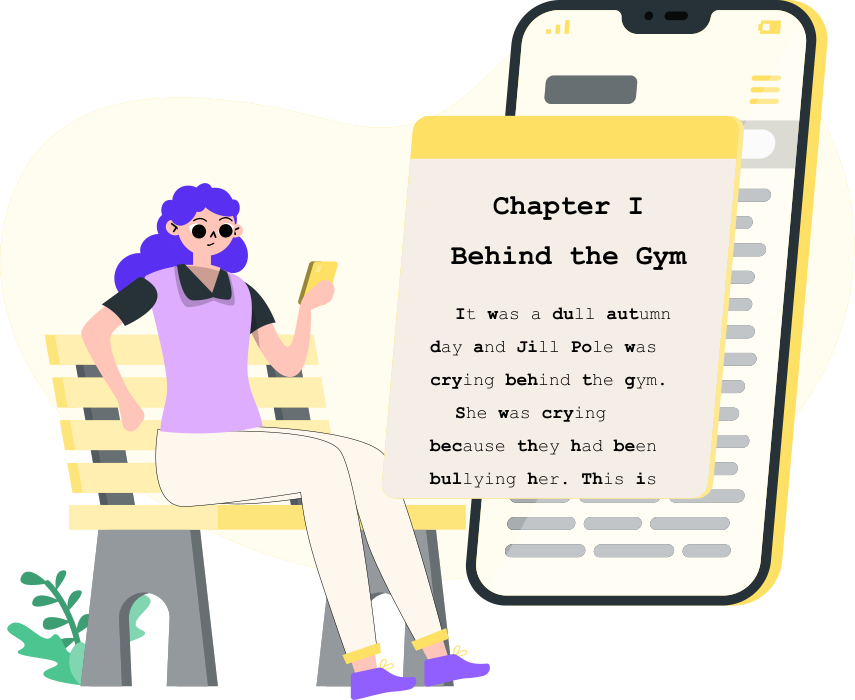
Then work through your notification settings and switch off everything that is not genuinely urgent, which will turn out to be almost all of it. Focus and Do Not Disturb modes let calls from a handful of people through while silencing the rest, so you can remain reachable in an emergency without being available to every app on the device. Turn one on as a reflex whenever you pick up a book, since it takes two seconds and it protects the entire session. If the book itself is on the device, a reader that fills the screen helps for the same reason, and Celer on iPhone and iPad strips the page back to the text alone with nothing else left in the corner of your eye.
The Power of Dedicated Reading Devices
A device that does only one thing is worth a surprising amount. An e-reader such as a Kindle Paperwhite carries no apps and barely any usable internet, so there is simply nowhere to escape to at the moment a paragraph turns difficult. If you read on a tablet instead, build a reading profile with almost nothing installed and every alert disabled, or just switch on airplane mode before you begin. Whatever you read on, make it single-purpose for that stretch of time, so that switching away requires a deliberate act rather than a thumb twitch. If the book you want on that Kindle arrived as an EPUB, convert EPUB to AZW3 and side-load it yourself rather than reading it on the phone you are trying to escape.
Crafting Your Cone of Silence: Controlling the Auditory Environment
Sound comes next, since a sudden bang and a constant background drone will each cost you concentration and ADHD lowers your tolerance for both. What you are aiming for is a sound environment you have chosen rather than one you are simply enduring, because a sound you selected on purpose stops registering as an interruption within a few minutes of starting.
The Science of Sound and How It Affects ADHD Focus
Sensory input frequently lands harder with ADHD, and sound is no exception, so background noise that other people filter out without ever noticing it can be genuinely intrusive for you. An unexpected sound cuts the thread instantly, and even a room that seems quiet usually has a fridge, a clock or passing traffic chipping away at your attention. There is a twist worth knowing, though: complete silence is not always the answer, because when there is nothing to hear, your own internal restlessness becomes considerably louder.
Tools and Techniques for Auditory Control
Noise-canceling headphones are worth what they cost, since they flatten the coffee shop, the boiler and the neighbors upstairs, and you can wear them with nothing playing at all. The alternative is to fill the space deliberately, using white noise, brown noise or instrumental music without lyrics to give yourself one steady sound in place of a dozen unpredictable ones. Try a few and notice which one you stop hearing fastest, because that is usually the right choice for you. Lyrics are the exception worth ruling out, as words in your ears compete directly with the words on the page.
A white noise machine does the same job without anything on your head, and an ordinary fan works surprisingly well as a cheaper version of one. If you want ideas that go beyond sound, our guide to ADHD reading strategies for adults covers the rest of the picture.
⏵
Use Earplugs: Cheap, small and genuinely effective, and a better option than headphones on days when having something clamped to your head for an hour is its own distraction.
⏵
Sound-Dampening Decor: Rugs, curtains and a soft chair soak up sound and remove the echo that makes small noises carry. A carpeted room is noticeably quieter than a bare one, and the difference costs nothing once the rug is down.
⏵
Strategic Placement: Read away from the hallway, the kitchen and any wall thin enough to hear through, because where you sit turns out to matter about as much as what you sit on.
⏵
Communicate Your Needs: Tell the people you live with when you are reading and roughly how long for. Most interruptions happen because nobody knew rather than because anyone intended to break your concentration.
If losing your place mid-paragraph is what brought you here, Celer’s moving highlight fixes exactly that.
Quieting the Inner Chatter: Pre-Reading Mental Preparation
The hardest distraction of the four is not in the room at all. Racing thoughts, restlessness and a mind that refuses to settle are standard ADHD territory, and no amount of silence in the environment does anything about them. What helps is spending two minutes settling yourself before you open the book, in much the same way you would clear a desk before starting work, and those two minutes reliably buy back more reading time than they cost.
Understanding Internal 'Noise' and ADHD
People often describe the ADHD mind as busy or loud on the inside, and much of that noise comes from executive function, the set of mental skills that plan, organize and keep your thoughts pointed in a single direction. Reading draws on them constantly, from decoding an unfamiliar word to tracking who did what to whom across forty pages. While they are working hard they are also generating the chatter you are trying to read through, which is why concentration and mental noise tend to rise together. How efficiently executive function supports reading comprehension largely determines how long you can stay with a text at all.
Pre-Reading Rituals for a Calmer Mind
Warming up before you read works for the same reason it works for athletes. Decide what you want out of this particular session and roughly how long you intend to read for, because having an answer gives your attention something to hold onto when it starts drifting fifteen minutes in. It also hands you a clean place to stop, rather than trailing off at an arbitrary point with the feeling that you failed at something.
A couple of minutes of slow breathing genuinely does slow a racing mind, and so does moving beforehand, whether that means a short walk, a stretch or anything else that burns off restlessness that would otherwise follow you into the chair. If a to-do list is circling while you try to read, write the whole thing down before you start, because once it exists on paper your brain stops rehearsing it and hands the attention back.
⏵
Five Senses Check-in: Name five things you can see, four you can touch, three you can hear, two you can smell and one you can taste, or simply follow your breathing for a while. It takes a minute and it pulls you firmly into the present.
⏵
Set a Micro-Goal: Forget about reading for an hour and aim at one page, or at five minutes. A goal you are certain to hit is what gets you started, and starting is reliably the hardest part of the session.
⏵
Visualize Success: Spend thirty seconds picturing yourself reading calmly and enjoying what you read. It is a small thing that sets the tone you begin in, and the tone you begin in tends to persist.
⏵
Brain Dump: Take two or three minutes to write down whatever is nagging at you, then put the paper face down and leave it there until the session ends.
Comfort is Key: Optimizing Your Physical Reading Space
Physical comfort matters considerably more than most people expect it to. A bad chair, dim light or a room that is a degree too warm all turn into distractions in their own right, and an ADHD brain registers that low-level discomfort loudly rather than filtering it away. Sort these out and you remove an entire category of interruption you were never counting, and the effect shows up directly in how long you last before you want to stand up.
The Ergonomics of Engagement: Posture and Seating
Think honestly about how you actually sit when you read, whether that is curled over on the sofa or half-perched at a desk, because bad posture turns into aching shoulders and aching shoulders end sessions early. Aim for a supportive chair with your feet flat on the floor and your back roughly straight, and at a desk get the height right so your arms rest without any effort. Some people with ADHD read better in a beanbag or lying down, provided lying down does not simply put them to sleep. The target is relaxed but alert, and you will only find it by trying a few arrangements.
Let There Be (the Right) Light!
Light does considerably more than let you see the words. Too dim and your eyes tire quickly and sleepiness follows; too harsh and you get glare and, before long, a headache. Daylight is best, so put your chair near a window whenever that is possible, and otherwise choose warm diffused light in preference to a bare overhead bulb. An adjustable lamp lets you aim the light at the page and away from your eyes, which resolves most glare problems in one move. Colored overlays and different font settings help some people as well, a topic usually raised in connection with building an ADHD reading environment for children, though adults benefit from both just as much.
Personalizing Your Physical Setup for Sustained Focus
A few smaller details finish the job. Check whether the room is actually at the right temperature, since too hot or too cold will pull you out repeatedly, and keep a blanket or a fan within reach so the fix does not require standing up. Gather everything you need beside you before you begin, because getting up to find a pen is how twenty minutes quietly disappears. It is also worth testing a fidget toy, as giving restless hands something to do keeps the rest of you still for many people with ADHD. What you are building overall is a spot that tells your brain, the moment you sit down in it, that reading is what happens here.
This is not a setup you build once and never revisit, since what works this month may need adjusting next month and some days nothing works at all. Adjust rather than despair on those days. Get the digital distractions under control, take charge of the sound, settle your head before you open the book and make yourself physically comfortable, and you will read for longer and enjoy far more of it. If you want more background, there are useful resources on neurodiversity and reading. It is worth remembering what you are aiming at, too: not flawless unbroken concentration, which nobody actually has, but a setup that stops fighting you and lets you read the way you naturally read. For more angles on this, guides to reading with ADHD are worth a look.
Try Celer free on iPhone and iPad
⭐️⭐️⭐️⭐️⭐️
"The only time I’m excited to read is with your app."
Dorcas
Related articles
Effective Note-Taking Strategies for ADHD Readers
Four systems that hold up against an ADHD brain, what each one is good for, and how to adapt them so you actually keep using them.
The Benefits of Reading Aloud for Adults with ADHD
Saying the words out loud engages three senses at once, forces a slower pace and gives you an audio version of the text. Here is how to use it.
Building a Consistent Reading Routine for ADHD
How to build a reading habit that survives contact with an ADHD brain, plus guidance for parents supporting teens.