Choose reading mode (more settings inside the app)
The session itself rather than the surrounding advice: how long to sit, who reads what, and what to do in the moments when it starts going wrong.
Reading together with a child who has ADHD goes best when you treat the session as a shared job rather than a performance they have to get through. Keep it to around ten minutes, take the harder share of the reading yourself, swap turns in units small enough that your child can see the end of their turn from the start, supply a word within a few seconds when they stall on one, and stop while things are still going well instead of at the end of the chapter. Most of what goes wrong in a shared reading session traces back to one of those five being off. What follows is about the interaction itself: who reads what, what to do when attention leaves the room halfway down a page, how to answer a stumble without flattening the mood, and how to finish in a way that makes tomorrow's session easier to start.

Four related pages cover the ground around this one, and it helps to know which is which before you read on. Our guide to supporting a child with ADHD through reading deals with the parent's wider role, school and homework included. Reading aloud to a child with ADHD covers the case where you do all the reading and they listen. Reading strategies for children with ADHD is about what the child does on their own, and the reading space is about the room you sit in. This page assumes all of that and looks only at the ten or fifteen minutes when the two of you have the same book open.
How long should a shared reading session last?
Around ten minutes, and you should be ready to stop sooner if the session is plainly finished. ADDitude's advice to parents is to set aside a reading slot and have the child read for no more than ten minutes in a screen-free room, and its guidance on comprehension is to begin with short passages and extend the time only once your child holds focus through them. The reasoning is worth stating plainly, because it decides how the whole session is run: one that ends while your child still has attention in reserve ends on a success, and one that runs until they come apart ends on a failure that both of you will remember tomorrow evening.
Short is also more ordinary than it feels in the moment. In Celer's own iOS reader, the median completed reading session across 8,125 sessions between August 2025 and August 2026 lasted under fifty seconds, and 43% of them ended within thirty. Two caveats travel with that figure and should never be dropped from it: a session there is any book opened and closed, so the shortest bucket mixes genuine reading with opens that were never reads, and those are Celer users rather than a measured ADHD population, since we collect no diagnosis data of any kind. It is not evidence about children with ADHD and we would not present it as any. What it does suggest is that brief visits to a book are the normal shape of reading on a device, which is worth holding onto on the evening when six minutes feels like a defeat. The full breakdown of those sessions, with every denominator attached, is published separately.
Stop by the clock, not by the chapter
Agree the length before the book opens and say it out loud, so that stopping is a plan you both made rather than something you impose once the evening sours. A chapter is a unit the publisher chose for the convenience of print, and it has no relationship at all to how long your child can concentrate, so using it as the finish line hands the decision to a stranger. Set a visible timer instead, and when it goes, finish the sentence you are in and close the book. Stopping mid-scene has a second advantage that surprises most parents the first time they try it, which is that an unresolved scene is the cheapest motivation available for tomorrow.
Who reads which part?
You take the harder share, and the split moves during the session rather than being fixed at the start. ADDitude's staged reading guidance for children with ADHD and learning disabilities is to have your child read some of the book themselves and then take turns reading aloud and listening to each other. The practical version of that is to open the session yourself. Your child arrives at the page having already spent the day being asked to do difficult things, and hearing you go first gives them a minute to settle into the story before any demand lands on them.
Once you are both in, choose a unit of exchange that your child can see the end of from where they are sitting. A paragraph is usually right for a child who finds decoding hard; a page suits a more fluent reader; a single line works on the bad evenings, and using it is not a step backwards. The unit matters more than the total, because what exhausts a child with ADHD is not the quantity of reading but the open-ended feeling of not knowing when their turn stops.
⏵
Turn by paragraph: The default for most sessions. Short enough to finish, long enough to carry meaning, and it puts a natural pause between the two of you every thirty seconds or so.
⏵
You narrate, they speak: You read everything outside the quotation marks and your child reads the dialogue. It cuts their share to something manageable while giving them the best lines in the book.
⏵
Echo reading: Read a line, then have your child read the same line back. Understood describes it as reading the first line and having kids read it back before you move to the second, which removes decoding from the task entirely.
⏵
Reading in unison: Both voices on the same words at the same time. Useful when your child is tired or self-conscious, because a mistake disappears inside your voice instead of hanging in the room.
⏵
They follow, you read: Your child keeps their finger on the line while you do all the reading. It is still a shared session, and on some evenings it is the only version available.
Echo reading and reading in unison have a second life as classroom techniques, and they hold up well past the early years. Our page on reading strategies for children with ADHD covers them as skills to practice, while here they are simply two of the ways to divide a page between you. Rereading the same passage a few times is also worth doing rather than avoiding: Understood's guidance on reading fluency recommends repeated reading of a short text at the child's level, and a passage your child already knows is the one where they will sound fluent for the first time.
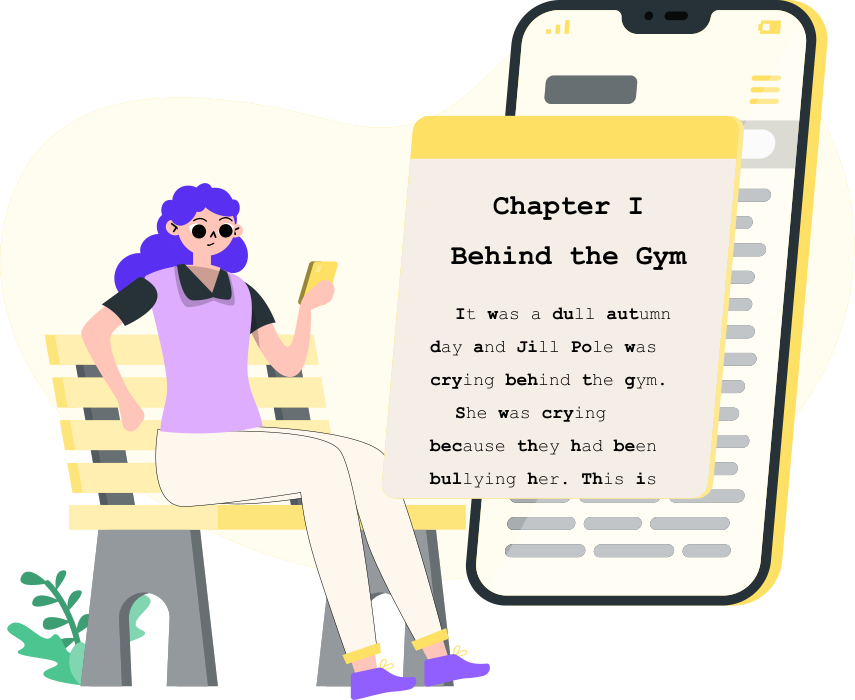
If losing your place mid-paragraph is what brought you here, Celer’s moving highlight fixes exactly that.
What do you do when attention breaks mid-page?
Hold the place with your finger, name what happened without any edge in your voice, and then decide whether the session continues or ends. Something along the lines of 'you have gone somewhere else, shall we get up for a minute' does the whole job: it tells your child you noticed, it does not accuse them of anything, and it offers a way back in. What you are avoiding is the reflex of repeating the last sentence louder, which is heard as displeasure however evenly it is delivered.
Do not restart at the top of the page either. Going back to the beginning turns a lapse of ten seconds into two minutes of rereading and tells your child, accurately, that drifting off costs them. Instead ask what the last thing they remember is, and resume from there. It usually turns out to be closer to where you stopped than either of you expected.
A short movement break is the most reliable repair available, and sixty seconds of standing up is generally enough. Come back to the book afterwards rather than treating the break as the end, but come back once, not three times: if the second reset fails, the session is over and the honest move is to close the book cheerfully while it can still be closed cheerfully. Building movement into reading in the first place is a larger subject, and our guide to setting up a reading space for a child with ADHD deals with the seating and sensory side of it.
How should you respond when your child stumbles on a word?
Say the word for them within a few seconds, unless they have asked for the chance to work it out. ADDitude's advice is exactly that, to supply the difficult word rather than leave your child struggling with it, and to let them decode it themselves only when they want to. Waiting in silence while a child grinds at a word feels like patience from the outside and feels like being watched from the inside, and it costs more attention than the word is worth.
Then say what their attempt got right, which is the part most of us skip. ADDitude gives the wording almost verbatim: 'The word is house, but your guessing home makes sense', or 'The word is house, but your guessing horse shows that you know the h and the s sounds'. It takes three seconds, it is true rather than consoling, and it treats the stumble as evidence of a strategy at work instead of a failure to be got past. Reread the sentence once with the right word in place so the meaning closes properly, then carry on.
Correct one thing per stumble and never two. A child who has just been given the word and then also told about the missing full stop and the rushed ending has learned that reading aloud is where the criticism happens, and that lesson outlasts every individual word you fixed. Keep a running sense of the ratio between the things you say that are warm and the things you say that are corrective, and if it has drifted, spend a session reading to them instead.
How do you choose a book to read together?
Pick something a level or so above what your child could manage alone, because you are carrying the decoding and the point of reading together is to spend that headroom on a better story. The book also has to be one you can genuinely stand, since children read your voice long before they read the page, and fifteen minutes of a parent politely enduring a book teaches them what books are for. Short chapters help more than short books do, and a series you can both get attached to solves the choosing problem for a month at a time. Our guide to choosing books for readers with ADHD goes further into matching material to interest.
Let your child choose more often than you do, and accept the rereading of something familiar without negotiating. A book they have heard four times is a book where they can predict the next line, and predicting the next line is what fluency sounds like from the inside. If the pages are dense, breaking the text into visible pieces before you start is a small preparation that pays for itself, and chunking reading for children with ADHD covers how to do it without making the book look like homework.
How should a shared reading session end?
End it on purpose, two or three minutes before your child would have ended it for you, and spend the last of those minutes talking rather than reading. ADDitude suggests stopping every few pages to ask what the story is mainly about, what happened first and how they think it will end, and the close of the session is the natural place for one or two of those questions. Keep it to a conversation, not a check: you are giving your child a chance to say what they made of it, which is also the moment you find out whether any of it landed.
Then say one specific thing you actually noticed. Not 'good job', which a child correctly reads as a formality, but the observation underneath it: that they worked out a hard word without help, that they kept going after the interruption, that they did the villain's voice properly. Praise aimed at the effort rather than the result is standard advice in ADHD parenting guidance, and it works here for a simple reason, which is that a child can repeat a behavior you named and cannot repeat a general approval. Finish by saying when the next one is. A session that ends with a plan is much easier to start than one that ends with a book being shut.

Does reading together actually help?
The honest answer is that shared reading has good evidence behind it in general and almost none of it collected specifically on children with ADHD, so most of the advice above is practice rather than finding. The nearest strong evidence is on dialogic reading, where the adult prompts and the child talks. A randomized trial by Dicataldo, Rowe and Roch, published in Children in 2022, randomized forty Italian preschoolers across three groups and trained the parents of the twelve in the treatment group in dialogic technique, finding better vocabulary, inferential comprehension and narrative comprehension in that group, along with longer shared reading sessions and more questions from the parents. Forty children in three groups is a small study, none of them selected for ADHD, and it should be read as encouraging rather than settled.
Two other findings are worth carrying into the evening. The first is that reading has to be practiced as reading: a randomized clinical trial of 216 children in grades two to five by Tamm and colleagues compared ADHD treatment, reading instruction and both together, and found that word reading improved in the groups receiving reading instruction but not in the group receiving ADHD treatment alone, while reading instruction on its own did not improve ADHD symptoms. Treating the attention does not deliver the reading, and the fifteen minutes you spend on a book is not a substitute for either.
The second is that the relationship side of this is measurable, if modest. A meta-analysis of behavioral parent training by Doffer and colleagues, covering 27 studies with 1,481 children in intervention conditions and 988 controls, reported sustained effects at follow-up on positive parenting and, more weakly, on parent-child relationship quality. That is not a study of reading, and the average follow-up was only about five months. It does support the least fashionable claim on this page: the way the two of you treat each other during these fifteen minutes is doing work of its own, separately from anything happening to the reading level.
The session is the unit
Nothing here needs a program or a purchase, and none of it requires you to be good at reading aloud. Sit down for ten minutes, carry the harder half, trade turns in pieces your child can see the end of, hand over a word the moment it sticks, and close the book while both of you still want to be there. On the evenings when that is impossible, read to them and count it. Progress in this is measured across terms rather than sessions, and the thing that decides whether you get those terms is whether tonight was pleasant enough for there to be a tomorrow. For the wider picture across ages and situations, our Ultimate Guide to Reading with ADHD collects the rest.
Try Celer free on iPhone and iPad

⭐️⭐️⭐️⭐️⭐️
"The only time I’m excited to read is with your app."
Dorcas
Related articles
Reading for Tests: ADHD Strategies for Academic Success
How to get through dense study material with ADHD, and how to read exam questions without losing marks to impulsivity.
Simple Reading Strategies for Children with ADHD
Twelve practical ways to help young learners with ADHD get past reading difficulties and start enjoying books.
Supporting Your Child with ADHD in Reading: A Parent's Guide
How to build a home where reading feels possible, and how to work with school so both sides pull the same way.