Choose reading mode (more settings inside the app)
Six graphic organizers, what each one is for, and the practical tips that decide whether they help or just add another blank page to fill in.
A graphic organizer for ADHD reading pulls the ideas out of a text and lays them somewhere you can see them, whether those ideas are the shape of a plot, the structure of an argument or a sequence of steps in a process. Instead of holding all of it in your head while you keep reading, you put it on paper as a map or a chart and let the page do the remembering. That takes a substantial load off working memory, which is usually the thing that makes reading hard with ADHD in the first place.
Six organizers between them cover almost everything you are likely to read: story maps, concept maps, Venn diagrams, flowcharts, KWL charts and timelines. What follows explains what each one does and when it is worth reaching for, so you can match the tool to the text rather than defaulting to whichever one you learned first. There are also some simpler visual tricks toward the end, for the many occasions when a full organizer is more effort than the job deserves.

Why Visual Aids Are a Superpower for ADHD Brains
Reading is demanding for anyone, and ADHD adds a set of specific obstacles on top of the ordinary ones. Focus, organization and working memory are all commonly affected, so information arrives as a jumble, or a detail vanishes before it has been properly filed anywhere. None of that reflects effort or ability, and pushing harder does not fix any of it, which is why a structural solution beats a motivational one. Our piece on how the ADHD brain tackles reading challenges covers the mechanics in detail.
Visual aids attack that problem head-on by laying information out in space rather than in a single line, which draws on a different and often stronger ability. Connections, hierarchies and sequences become things you can look at instead of things you have to hold, so the structure lives on the page rather than in your head. That is precisely where you want it when your own capacity for organizing is already under strain from the reading itself.
The Science Behind the Sight: Benefits Galore
These tools do real cognitive work rather than decorating a page. What they mainly support is executive function, which is the system reading comprehension runs on, and four benefits stand out in particular. Each of the four below targets a different part of what makes reading difficult, so it is worth putting more than one of them to work at the same time.
The first is structure. A wall of text offers nothing to grip, and every line looks about as important as every other line, which is exhausting before you have understood anything. An organizer splits that wall into pieces, shows which points carry weight and how they relate to one another, and the sense of overwhelm drops away almost immediately.
The second is engagement, since you have to fill the thing in and there is no way to do that on autopilot. Filling it in turns reading from something happening to you into something you are actively doing, and doing holds attention in a way that passively watching words go past never manages for long.
The third is memory, because visual information is easier to store and considerably easier to retrieve later. A finished organizer leaves you with a shape you can remember, and the individual details hang off that shape when you come back to the material a week or a month afterwards.
The fourth is reduced load. Once the structure exists on paper you are no longer responsible for holding any of it yourself, which frees your brain for the part that actually matters, namely working out what the text means and what you think about it.
Your Toolkit: Amazing Graphic Organizers for ADHD Reading
Graphic organizers use shapes, lines and short pieces of text to show how ideas relate to each other, and they bend to fit almost any text or task you put in front of them. The six below are the ones that reliably earn their place, along with what each is good for. Skip straight to whichever one matches the text currently on your desk.
1. Story Maps: Charting the Narrative Journey
What it is: a layout of a story's moving parts that you fill in as you read, covering the characters, the setting, the plot divided into beginning, middle and end, and the central problem along with its eventual solution. It amounts to a blueprint of the narrative, all of it on a single page where you can take the whole thing in at a glance.
How it helps: this is the organizer for fiction, since it pins down the main events, keeps their order straight and holds the pieces that are easiest to lose track of. Suppose you reach chapter nine unsure who somebody is or how they ended up where they are. A story map becomes the reference you glance at instead of flipping back through forty pages hunting for the moment you missed, which is usually where the reading session dies.
2. Concept Maps (or Mind Maps): Connecting the Dots
What it is: one central idea in the middle of the page with related ideas branching outward from it, and lines or arrows marking how those ideas connect. It grows outward into a web rather than marching down the page in order, which suits a mind that jumps between ideas rather than proceeding through them in single file.
How it helps: this is the one to use for non-fiction and for anything genuinely complicated. You can use it to dump what you already know before you start reading, to catch ideas as they arrive, or to pull the whole subject together once you have finished. Making abstract relationships visible is exactly what lifts ADHD reading comprehension, because it lets you see the whole shape of an argument at once instead of one piece at a time.
3. Venn Diagrams: Seeing Similarities and Differences
What it is: two or more overlapping circles, where anything the subjects share goes into the overlap and everything unique to each one goes into the section that stands alone. It is the simplest organizer here and probably the most underused.
How it helps: reach for it whenever you are comparing two things, whether that is two characters, two historical periods or two scientific processes. The comparison becomes something you can look at rather than something you have to argue out silently in your head while also holding both subjects in mind. The empty spaces are useful in their own right, since they push you back into the text to find whatever belongs there.
4. Flowcharts: Following the Process
What it is: boxes and arrows laying out steps in order, with diamonds marking the points where a decision splits the path in two. Each shape carries a particular meaning, so the diagram tells you what sort of thing is happening at each stage before you have read a single word inside it.
How it helps: use a flowchart whenever the order of things is what matters, which covers a process, a chain of cause and effect, or the sequence of a plot. If a text describes something that happens in steps, such as an experiment or a run of historical events, a flowchart makes the sequence obvious at a glance and keeps it that way for as long as you need it.
5. KWL Charts: What I Know, Want to Know, Learned
What it is: three columns filled in at three separate moments, with K for what you already Know, W for what you Want to find out, and L for what you Learned, completed once the reading is done.
How it helps: the K and W columns get filled in before you read anything, which means you begin with a reason and a question rather than simply beginning, and that alone sharpens focus considerably. The L column then gives you somewhere definite to put whatever you found, so the session ends with visible evidence of progress. It builds active reading strategies for children with ADHD almost without anyone having to teach them separately.
6. Timelines: Placing Events in Order
What it is: a single line with events marked along it in the order they actually happened, so that time runs left to right in front of you instead of having to be reconstructed each time you need it.
How it helps: it is close to essential for history, for biography, and for any story that jumps around in time rather than telling itself in order. If sequencing is difficult for you, or if you keep losing track of how something early on caused something much later, a timeline puts the whole span into one view and holds it there while you read.
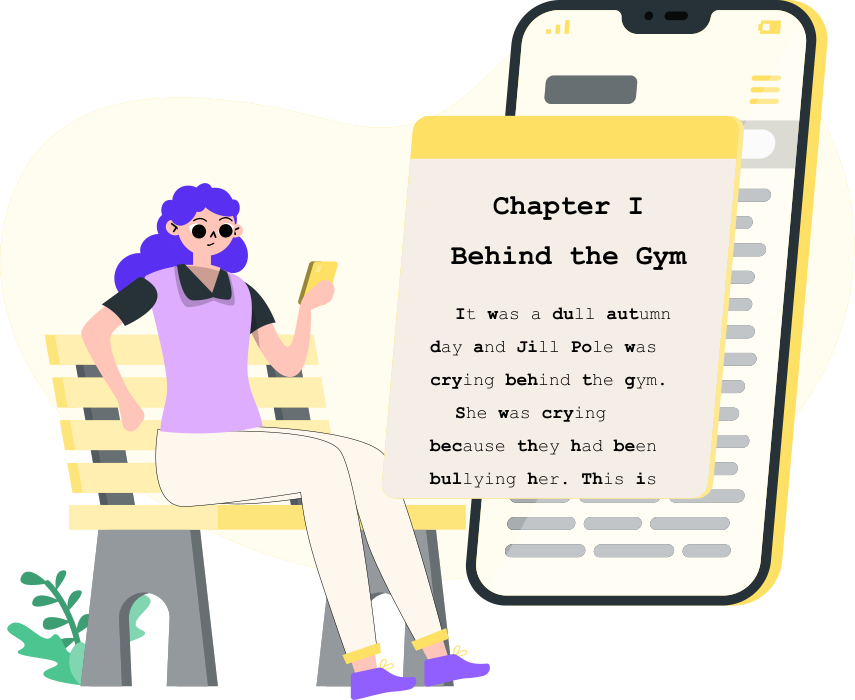
If losing your place mid-paragraph is what brought you here, Celer’s moving highlight fixes exactly that.
Beyond the Page: More Visual Tricks Up Your Sleeve
Organizers are not the only option available, and sometimes a full one is more than the task requires or more than you have the patience for on a given evening. The smaller visual moves below take seconds rather than minutes, need nothing beyond a pen, and still make a real difference to how much of the text you take in:
⏵
Color-Coding: Give each kind of information its own color, such as yellow for main ideas, green for supporting detail and blue for unfamiliar words. Patterns begin to jump out on their own, and the page stops looking uniformly gray.
⏵
Highlighting Strategically: Teach selectivity above everything else, because highlighting an entire paragraph marks nothing at all. Highlighting one sentence means you decided that sentence was the important one, and the deciding is where the thinking actually happens.
⏵
Reading Strips or Guided Readers: A colored transparent strip, or a card with a slot cut into it, reveals one or two lines while hiding the rest. Less text visible means less to be pulled away by, and it solves the problem of losing your place at the same time.
⏵
Visual Timers: A Time Timer shows the remaining minutes physically shrinking in front of you, which makes an abstract twenty minutes concrete. There is then no anxious wondering about how much longer this is going to go on for.
Making Visual Aids Work for You: Tips and Tricks
What matters most is finding the organizer that genuinely fits the reader and the material, and then using it often enough that reaching for it becomes automatic rather than a decision to be made each time. For more ideas aimed at teachers and parents, ADDitude Magazine has a good collection of reading help articles.
Choosing or Creating the Right Visual Aid
Keep it simple, because clarity is the entire point and a cluttered organizer is every bit as hard to read as the text it was supposed to replace. Aim for clean lines, generous white space, and fewer boxes than you think you need, made larger than feels necessary. The temptation to add one more category should usually be resisted.
Let the student make it theirs, whether through their own choice of colors, their own symbols, or an organizer they designed from scratch for a particular book. Something a student owns tends to get used week after week, while something handed to them fully formed tends to get filled in badly once and then forgotten in a drawer.
Use color deliberately rather than decoratively. It is genuinely useful for separating categories and for holding attention on the page, but a rainbow with no system behind it is just noise in a brighter form. Two or three colors is plenty, and every one of them has to mean something specific and consistent.
Then repeat yourself. Variety has its place, but using the same organizer for the same kind of task builds familiarity remarkably fast, and familiarity is what makes the tool disappear. Once that happens, no effort goes into working out how the organizer functions and all of it goes into the text instead.
Incorporating Visual Aids Effectively
⏵
Model and Practice: Never simply hand over a blank template and expect it to be used well. Fill one in yourself first, thinking out loud so they hear how the decisions get made, then complete a couple together before they work alone. That kind of explicit teaching sits at the center of educator tips for ADHD reading support.
⏵
Integrate, Don't Isolate: Use the organizer across the whole reading process rather than only at the end: before reading to surface what they already know, during reading to capture whatever comes up, and afterwards to pull it together and review.
⏵
Offer Choices: Put two or three suitable organizers in front of them and let them choose one, since that hands them a degree of control and accommodates genuinely different preferences. Reading Rockets has useful material on diverse learning needs.
⏵
Digital or Paper?: Try both before deciding, because some students with ADHD love dragging boxes around inside an app while others need the feel of a pen and the fact that a sheet of paper cannot show them a notification. Neither answer is the right one for everybody.
The Bigger Picture: Empowering ADHD Readers
Graphic organizers do considerably more than help with a single chapter, because they give a student with ADHD a route through a text that genuinely works, and confidence tends to follow from having a route. Reading stops being the subject they quietly fail at and becomes something they have a method for, and that method plays to the way they think rather than working against it every evening.
Finding the right combination takes time and a fair amount of trying things that turn out not to suit, so be patient, stay curious about what works, and count the small wins as genuine wins. You are building two things simultaneously: a set of tools the reader can choose between depending on what is in front of them, and a relationship with reading that is not founded on dread.
Used properly and used consistently, these visual strategies open reading up for students, parents and teachers alike, and they keep paying off long after the particular book is finished. For the wider set of approaches that surround them, our Ultimate Guide to Reading with ADHD has plenty more to draw on.
Try Celer free on iPhone and iPad
⭐️⭐️⭐️⭐️⭐️
"The only time I’m excited to read is with your app."
Dorcas
Related articles
Reading Together: How to Share a Book with a Child Who Has ADHD
The session itself rather than the surrounding advice: how long to sit, who reads what, and what to do in the moments when it starts going wrong.
Reading for Tests: ADHD Strategies for Academic Success
How to get through dense study material with ADHD, and how to read exam questions without losing marks to impulsivity.
Simple Reading Strategies for Children with ADHD
Twelve practical ways to help young learners with ADHD get past reading difficulties and start enjoying books.